Why We Cull Nuisance Wildlife — What the Numbers Say
I've written before about why I started hunting — to protect the rice fields my friends and I grew, from wild boar. That is my honest, unvarnished reason.
But this time, I'd like to step back a little and think about why we cull nuisance wildlife from a wider view. Our guide will be numbers. Numbers reflect reality more directly than feelings ever do.
Nationwide: 18.8 billion yen a year
Let's start with Japan as a whole. In fiscal 2024, damage to agricultural crops caused by wild birds and animals came to:
- Damage value: roughly ¥18.8 billion
- Damage area: roughly 40,000 hectares
Numbers large enough to make your head spin. The biggest culprits are sika deer (about ¥7.85 billion) and wild boar (about ¥4.46 billion), followed by brown-eared bulbuls, crows, and monkeys. Across the country, deer account for a large share of the damage.
In Seiyo, wild boar is the great enemy
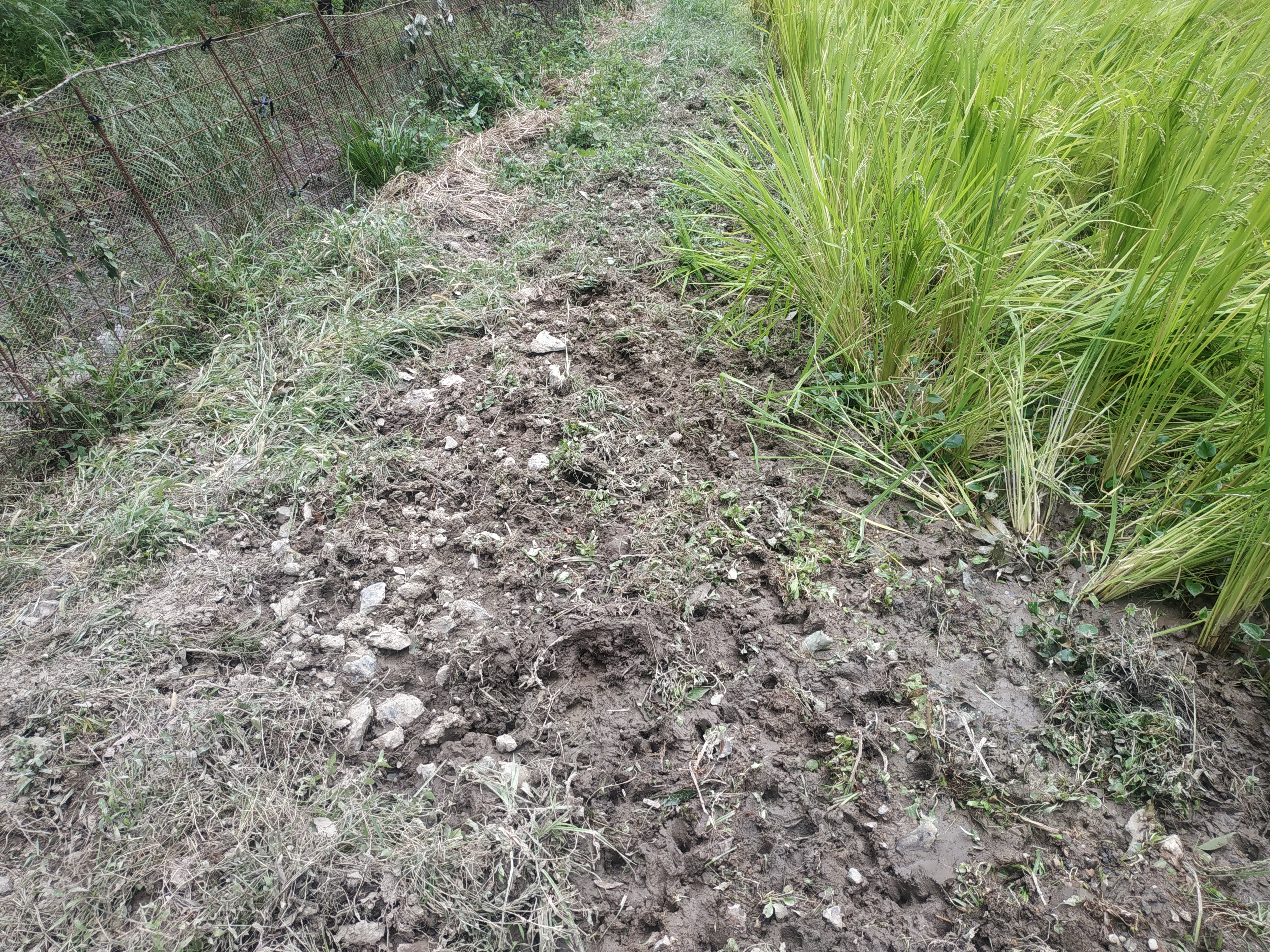
So what about here in Seiyo City? Here is the same fiscal 2024 damage, broken down by animal:
- Wild boar: about ¥20.36 million
- Brown-eared bulbul: about ¥12.41 million
- Crows: about ¥2.52 million
- Great cormorant: about ¥1.35 million
- Japanese macaque: about ¥430,000
- Sika deer: about ¥40,000
A total of roughly ¥37 million.
Nationally, deer sit at the center of the damage — but in Seiyo, the picture is different. The most serious problem here is wild boar. And bulbul damage to fruit trees makes up a large share as well. The lineup of adversaries changes from region to region.
The deer are changing
That "in Seiyo, it's boar" picture, however, is slowly beginning to shift.
Over the past three years or so, the number of deer being caught has risen considerably. When I first started trapping, we caught no deer at all. Now, we catch them reliably. Out in the field, you can feel it on your skin — the mountains are quietly changing.
Trapping on the ground in Seiyo
Against this damage, Seiyo City has kept up a patient, steady effort.
For wild boar, since fiscal 2010, more than 1,000 animals have been caught every single year. That is a remarkably high level even within Ehime Prefecture. Behind those numbers are the hands of a great many people who have kept walking into the mountains.
It doesn't end with the catch — receiving the life
And here is the most important part.
A life we take is not simply "eliminated" and forgotten. At Seiyo City's gibier processing facility, in fiscal 2024:
- Wild boar: 326 animals
- Sika deer: 123 animals
were received and put to good use as meat. These are the animals, out of all those caught, that were used as gibier.
A life taken to protect our fields, received with gratitude rather than wasted. There is a cycle in that.
We take, in order to protect. We receive, in order to live.
We cull nuisance wildlife to protect this community's crops and its way of life. And the lives we take, we carry through to the table.
"Protecting" and "receiving" are not two separate things. They are a single act, connected by one unbroken line.
We stand inside that cycle — shouldering both the weight of taking a life, and the gratitude of receiving it.
Numbers teach us reality. ¥18.8 billion. ¥37 million. 1,000 animals. 326 animals. Beyond every one of those figures, there is a field that was protected, and a life that was received.
ZEROSPHERE / The Keeper of Zero